Wednesday, September 6, 2017

Instant Settlement: Cities


lingxiang1982.cgsociety.org/art/photoshop-big-church-423228
Inner City. Inner. City. Pressure. (Inna citeh preshaaaa!)
As we continue working our way upwards in these generator articles, we've finally reached the scale that the original generator was used for. At the city scale, each die represents a ward, which is like a neighborhood within the city. Cities usually begin in a certain ward and grow outwards, adding a new section of wall to cover the latest expansion.

At this point, a city isn't something you can just throw together and slam down in front of your players. So why are we using a random generator?

Here's some situations that could use the random generation of an entire city:
  1. You're playing a game in an area without any established civilization, and want to quickly generate a place where you can run a city-based quest.
  2. A city was recently destroyed by an attack or disaster, and the inhabitants are rebuilding. However, it isn't quite the same, and when they finish it looks like a brand-new city.
  3. Your players are teleported or travel to a distant land they have never been to. They see a city in the distance, and you need it quickly.
  4. The city shifts every once in a while, each time they visit it the features are familiar but in slightly different places.
  5. You're planning a long campaign, and you want a home base city, but need some inspiration.

In any of these situations, you'll probably want to know beforehand the players are visiting the city, to give yourself time to roll it, map it, and figure out the specific details. Just like the town generator, cities aren't placed randomly - they are huge hubs of trade and commerce, and will always reflect that.

Also, if you do want to use the shifting city idea, I'd suggest you write down your results and only reroll to change the position of the dice.

Instant Settlement: City

raphael-lacoste.deviantart.com
I saw a city on a hill... that kept shifting in weird ways
Roll the following dice:
1d4
3d6
2d8
1d10

Once again, each die represents a feature of the city. Don't worry about keeping the dice in a tight formation. Space between dice can be taken up by residencies. However, you will want to note the centermost feature and the outermost feature. These will determine the history of the city, as cities begin as towns and grow outward. The center die will speak to the city's creation, and the outer die will speak to a recent event or conflict experienced by the city. If the adventurers solve that conflict and return, just roll 1d10 and create a new conflict using that number's "outermost die".

Start with the d4 and work your way upwards. If any number is repeated, replace the number on the higher die with the lowest available number. So if you roll a 3 on a d6 AND the d10 (and 1 is already on the d4) the d10 would become a 2. The highest die becomes the highest number, so if you roll a 1 on the d4, d6, and d10, they would become 1, 2, and 3 respectively.

A few notes on city structure: NPCs are about 60% Commoners, the remainder have occupations (such as guard or acolyte) that give them better stats. Anywhere from 50-75% of the city's population lives in the surrounding farmland and uses the city only for its features. Nearly any profession can be found within the city walls, and commoners will always belong to some sort of trade or craft.

Here's our example roll.

And, as usual, here's the same roll with the numbers corrected and the center/outermost dice circled.
Now we can get to work!


Die Results
1. Resources
2. Noble Ward
3. Defenses
4. Trade Ward
5. Slums
6. Temple Ward
7. Embassies
8. Cemetery
9. Gardens
10. Oddities

1. Resources

Cities are chosen because they have a wide access to trade, travel, and natural resources. A city is always a hub for major trade routes, and nearly always near a source of natural resources such as a mine. A standard city has a population of 8,000 due to its easy access to these resources.

If a city doesn't have a nearby resource, it became populated because it was a hub for major trade routes. Make sure there are at least 6 roads leading from the city, all headed to towns or other cities.

The type of die determines the resources of the city.
  • 1d4 - The city is located on a major body of water, like a lake, river, or ocean. Ship trade is common.
  • 1d6 - The city is surrounded by fertile farmland that provides incredible bounty each harvest.
  • 1d8 - The city is near a massive mine, with some parts of the mine extending under the city.
  • 1d10 - The city is built near a forested area. The forest is (naturally or magically) able to keep up with the massive amounts of hunting and logging the city requires.
Additionally, note the position of the die:
  • If the die is the centermost die, the city was founded as a town due to the nearby natural resource. Over time, trade exploded, either as demand for the natural resource grew or as people became more common in the area.
  • If the die is the outermost die, the natural resource related to the city has been producing less in recent years. The city is worried that something might be happening (naturally or magically) to cause this. Many citizens are in a state of panic.

2. Noble Ward

A city requires a lot of leadership. There are a few levels to a city's leadership: one noble presides, usually a King/Queen or Lord Mayor. Below them, many layers of nobility share responsibility for the surrounding areas and government functions. Finally, an elected city council represents the interests of the middle class. A strong ruling class gives a city much better leverage in trade negotiations and political disputes with other cities and countries, increasing the wealth in the city. A noble ward increases a city's population by 1,000.

If a city doesn't have a noble ward, the city council rules the city. There may still be some upper-class citizens, even those of Noble blood, but they have no real say in the affairs of the city. Additionally, the city has a reputation of being somewhat lax in its laws.

The type of die determines the style of government.
  • 1d4 - The city is a Monarchy. Either the King/Queen lives there and rules directly, or the Lord Mayor rules by decree of the King/Queen. Bloodline matters, and marrying into nobility can be a method for gaining power.
  • 1d6 - The city is an Oligarchy. The presiding noble has their own small council that determines the laws of the land. Politics and loyalty are the most important factors of gaining power.
  • 1d8 - The city is a Militocracy or Magocracy (ruled by military or magical might). The presiding noble is a hugely influential figure in this area. Joining an organization like the military or wizard school can grant a better reputation, and those near the top of the organization can gain real political power.
  • 1d10 - The city is a Plutocracy, with the wealthiest noble acting as the de facto presiding ruler. They keep a network of bodyguards, spies, and confidants to protect themselves. Gaining money and influence is the path to power.
Additionally, note the position of the die:
  • If the die is the centermost die, an ancestor of the presiding noble was the founder of the city. He is something of a legendary figure among the populous, and the nobility works to ensure the stories of his exploits leave out any scandalous bits.
  • If the die is the outermost die, power in the city has recently changed hands. The new ruler is quite different from the previous one, and people are discussing it heavily. It could be a new, terrible ruler, or it could be the first seemingly good ruler in a while and people are suspicious.

3. Defenses

The world of fantasy is dangerous, both due to monsters roaming the wilderness and political disputes among countries. It should go without saying that every city has a standing army available, which may or may not also work as the city watch. Additionally, every city of decent size has walls, which usually expand outwards to form wards within the city. However, there is quite a bit of variance in how much devotion to military might a city delegates. A city with strong defenses can increase its population by 1,000.

If a city doesn't have strong defenses, it will still have walls and a city watch. However, the watch is mostly volunteers, and has likely never mobilized against a major threat (such as another army, a dragon, or worse). If such an event occurs, the city may suffer massive damage.

The type of die determines the primary method of defense.
  • 1d4 - The city boasts a standing army. They are well trained and all of their leadership has fought in battles, either near the city or at the border of the country.
  • 1d6 - The city has a small engineering force that develops defensive siege weapons. They still employ foot soldiers, but the weapons are their first line of defense.
  • 1d8 - The city has a team of royal wizards that provide magical defenses for the city. They still employ foot soldiers, who are trained in how to avoid friendly spell damage and take out enemy mages.
  • 1d10 - The city is protected by a broad magical effect that has been in place for longer than anyone can remember. The site has always been holy or at the crossing of powerful leylines, and the city sprung up around it.
Additionally, note the position of the die:
  • If the die is the centermost die, the city was founded as a strategic hold against an encroaching force. The border it protected may or may not still be contested, but soldiers in this city are treated with extra respect.
  • If the die is the outermost die, the city recently received word of a major threat (such as an army, dragon, etc) planning an attack on them. The entire city is working to shore up their defenses, and could certainly use any help they could get.

4. Trade Ward

Much like a town, trade is the lifeblood of any city. However, unlike a town, cities are never known for particular goods or services - a city will attract enough merchants that you can find anything here. A trade ward is a staple in any city, but the presence of a guild-supported ward increases the population by 1,000.

If a city doesn't have a guild-supported trade ward, there will be marketplaces spread through every ward, and the city will be infamous for its extensive black market for less-than-legal goods and services.

The type of die determines the guild's power and influence.
  • 1d4 - Craftsman's Guilds run the trade ward, ensuring fair prices for manufactured goods. They hold some influence of the rulers of the city, but won't flex it as long as they are allowed to buy and sell freely.
  • 1d6 - The city has developed a Merchant's Guild due to the high number of vendors that reside within the ward. The guild lines the pockets of the nobility, though whether this influence amounts to much depends on the temperament of the rulers.
  • 1d8 - A Transmuter's Guild has gained leverage over the trade ward simply by being able to craft goods that no other guild can. The city is well-known for selling hard-to-find magic items, though the guild prefers to stay out of political affairs.
  • 1d10 - What appears to be a simple craftsman's guild is actually a thieves' guild. They put on a good front, but anything and everything can be bought and sold here. The rulers remain mostly unaware of this, in part because the guild keeps those who know of its existence well-paid and quiet.
Additionally, note the position of the die:
  • If the die is the centermost die, the city began as a humble trading post. In fact, that trading post still stands at the center of the city, though it has been utterly eclipsed by the multi-story stone shops that surround it. Still, it remains a source of pride and a common traveler's destination.
  • If the die is the outermost die, a new guild has shown up in town and is offering goods at lower prices than have been established. Though the ruling guild would love to have them removed, the offenders have gained political influence that cannot be easily shaken off. A political power struggle is on the horizon.

5. Slums

A city is a hub for resources, but not everyone has the luck or skill to compete with merchants and nobles. Though nobody chooses to be homeless, a city at least offers protection from the wilderness for those who have nowhere else to turn. If a city has a dedicated ward for shanty-style housing and communal living, the population will be driven up by those who travel to seek refuge. A slum adds 8,000 to a city's population.

If a city doesn't have a dedicated slum, there will be beggars and urchins in every ward, and orphanages will be spread throughout the city instead of being concentrated in the slums. There may or may not be laws prohibiting busking in the noble ward.

The type of die determines the general attitude of the city towards its lower class.
  • 1d6 - An unfortunate necessity. The city provides some resources to help keep the poor free from disease and remove the dead, but provides little other assistance. There are a few local organizations dedicated to feeding, clothing, and housing who they can.
  • 1d8 - A challenging priority. The city provides housing, food, and clothing to the poor, and those who are able to work can apply for job training at local guilds. Many organizations exist to assist in these tasks, and to rehabilitate those who are sick, addicted, or disabled.
  • 1d10 - A problem to be dealt with. The city doesn't provide much in the way of support, except for city guards that patrol the streets and keep an uprising from happening. There are a few local organizations that try to help the truly destitute, but they are spread thin and struggle to make a difference.
Additionally, note the position of the die:
  • If the die is the centermost die, the city was formed as a refuge during a time of great strife. Depending on how the city treats its lower class, this event could be remembered as the foundation of the city's growth, or as a messy part of history best ignored.
  • If the die is the outermost die, members of the lower class have been suffering from a mysterious illness. The city hopes to keep it contained to the slums, but it could spread easily. The severity of the disease and the cause of it are being investigated.

6. Temple Ward

Even in a setting with few Gods, any population of commoners will require space to worship whatever Gods they prefer. A Temple Ward is a state-sanctioned worship space which will also provide services like healing, counseling, and ceremony space. It also gives the city a bit of reputation for morality, whether or not the rest of the city actually follows the code of the Gods. A Temple Ward increases a city's population by 1,000.

If a city doesn't have a Temple Ward, then small churches are mixed in with the other wards, and usually reflect the needs of that ward: the Trade Ward has a church of the God of Commerce, the Noble Ward has whatever God the Royalty worships, etc.

The type of die determines the structure of the temple ward.
  • 1d6 - Contains temples based on a multitude of good-aligned Gods. Most prominent is the God that the nobility worships, but churches and shrines in this area cover a wide variety of Gods. However, all the worship that occurs here is directed at benign deities.
  • 1d8 - Contains a lot of Temples dedicated to one God - the God that the nobility worships. The buildings are quite lavish, and this essentially serves as an extension of the Noble Ward. Small shrines in other wards cover any other Gods that people might worship, but the majority of the population has joined in the worship of the main God.
  • 1d10 - Contains churches and shrines to any God that has enough followers. Good and Evil Gods alike have temple space here. The city has strict laws that prevent infighting amongst worshippers whose Gods are enemies. The nobility worships several Gods, including at least one God generally considered evil, which is why they enforce the situation.
Additionally, note the position of the die:
  • If the die is the centermost die, the area was considered a holy site long before the city existed. As worshippers flocked to the area, the city formed out of necessity.It is still a common site for religious pilgrims to visit and study.
  • If the die is the outermost die, the city recently changed its policy on what Gods can or cannot be worshipped here. Choose a structure of the Temple Ward that didn't get rolled - until about a month ago, this was the norm. The people might be in uproar about the change, or there might be a quiet revolution happening. Either way, the worshippers who were kicked out (or now have to share their space) aren't happy.

7. Embassies

A city is fueled by trade, and sometimes trade comes from distant lands. Foreign diplomats may wish to have a foothold in a city, as keeping an eye on their trade partner can benefit them greatly. Additionally, having dignitaries from a foreign land encourages citizens of those lands to visit, and a tourism industry can crop up. This increases the population by 3,000.

If a city doesn't have a dedicated embassy, visiting dignitaries simply stay within the noble ward. Additionally, trade within the city doesn't extend across country borders, either due to distance, conflict, or some kind of inhibiting terrain.

The type of die determines the most notorious embassy within the city.
  • 1d8 - An embassy from a country that is significantly more powerful or wealthy than the city's country. They throw extravagant parties and many nobles support trade with the other country. It's a well-known secret that the larger country is trying to gain a strong political foothold using the city.
  • 1d10 - An embassy consisting entirely of members of another race, such as elves or dwarves in a human city. The area is a safe haven for members of that race, and the city's attitude towards them varies from person to person. Some say their goods and services will put honest folk out of work, others welcome a new culture.
Additionally, note the position of the die:
  • If the die is the centermost die, the city formed on the site of an ancient peace treaty between two nations. Statues of the people at that meeting decorate the city. To this day, the two countries have been staunch allies.
  • If the die is the outermost die, a country that has an embassy within the city is nearing a declaration of war upon the country the city resides in. Members of the embassy may be divided on the action, or they may be united for or against the city. Whatever they believe, citizens have made pleas and protests at the embassy in regards to the conflict.

8. Cemetery

Death is a part of life, and many cities have a dedicated graveyard to deal with the massive amount of bodies that a thriving city can generate. The cemetery can also serve as a park for civilians, and often has city guards assigned to it at night in order to stop necromancy. A cemetery allows a city to be cleaner and healthier, increasing the population by 1,000.

If a city doesn't have a dedicated cemetery ward, there is a guarded plot of land outside the city walls used as a graveyard. However, this generally means it's easier for unscrupulous wizards to get dead bodies for their dark rituals.

The type of die determines the layout of the cemetery.
  • 1d8 - The cemetery is divided between nobility and commoners. A small wall or fence separates the two, and there are separate entrances for each side. The nobility have large mausoleums and statues, while the commoners have simple grave stones or markers.
  • 1d10 - The cemetery is for commoners only. The nobility either have their own grave sites in the noble ward, or prefer cremation.
Additionally, note the position of the die:
  • If the die is the centermost die, the city was founded at the site of an ancient battle, where a great hero made their last stand against a tide of foes. The hero has statues throughout the city, and visitors to the city can learn a lot about the ancient war and the hero.
  • If the die is the outermost die, bodies have been disappearing from the cemetery. It is unknown who is behind this and what their purposes are, but there's good money to be made getting to the bottom of it.

9. Gardens

People enjoy nature, but the wilderness outside a city is dangerous, even if it's populated with villages and farmhands. People live in cities because it affords them protection, but often they bring a bit of the outside in with them. A garden also brings people to the city, increasing the population by 1,000.

If a city doesn't have a dedicated garden, then houseplants and flowers in windows are quite common, and decorate the sides of the streets.

The die that rolled the natural resource determines the type of garden.
  • 1d4 - The garden is full of tropical plants and small ponds. The ponds are well-stocked, and people enjoy swimming and fishing.
  • 1d6 - The garden is built around a rare patch of trees which provide contrast for the surrounding farmlands.
  • 1d8 - The garden is built around a massive boulder, which has been carved and painted by hundreds of citizens over the years. The decorations may or may not have a common purpose - e.g. declarations of love
  • No natural resource - The garden is actually a massive tree that has been hollowed out or has houses built into its branches. There is quite a bit of history behind the tree, and how it came to grow at these crossroads.
Additionally, note the position of the d10:
  • If the die is the centermost die,  the garden contains a magical plant that has a unique property. This site has always produced this type of plant, and the city formed around this area.
  • If the die is the outermost die, the garden has recently been dying out. The citizens are concerned, and the nobility doesn't seem to have the resources to fix the problem. The cause could be mundane or magical.

10. Oddities

No two cities are alike, but some are even stranger. If a city has an oddity, it's well-known for it. People might travel across the world just to see it. These will be less extreme than the town oddities, since many people still need to live here and trade normally. Most cities don't have oddities, and having one doesn't make a big dent in population.

To determine the oddity, total up the natural results of the 3d6 and consult below.
  • 3: A God has taken up permanent residence in the city. They are very popular and receive many visitors, as well as many threats.
  • 4: The city is a few steps out of time. It exists a few hours in the future. Doesn't affect trade much, but those who leave the city get a three-hour headstart on their journey.
  • 5: Strange weather: food, animals, or even fire could fall from the sky. Doesn't happen terribly often, but only happens here.
  • 6: A demigod has taken up permanent residence in the city. They are respected and feared, and people try to get on their good side.
  • 7: A magic forge within the city can be used to create new spells, magic users flock to learn its secrets
  • 8: A certain school of magic (or all magic) is particularly potent within the city walls
  • 9: A certain school of magic (or all magic) simply doesn't work within the city walls
  • 10: The city is built on top of a massive dungeon, attracts adventurers
  • 11: The city is the only place that can produce a certain kind of resource. It's very valuable and highly coveted.
  • 12: A seer foretold the birth of a world-conquering hero would happen in this city. It hasn't happened yet, and people wait anxiously.
  • 13: The city is run by an immortal vampire. They take extreme precautions to stay alive, and may or may not be within the public's awareness.
  • 14: Airship manufacturing warehouse.
  • 15: A public teleportation circle allows easy travel to another city. Heavily regulated
  • 16: Nobody can die within the city's walls, they come back within 1d6 hours. Bodies are taken elsewhere.
  • 17: The city exists halfway between the material plane and another plane. Trade is conducted with the other plane, and strange goods and services can be found here. Fortunately, it's a very civilized part of that plane.
  • 18: Another city exists directly beneath this one, except it's upside down and gravity is reversed there. Roll a new city and use that one.

Additionally, note the position of the d10:
  • If the die is the centermost die, this oddity has existed for some time. People within the city are used to it, but it still astounds visitors.
  • If the die is the outermost die, This is a recent change or discovery. The civilians are still reeling from the effect it is having on their lives.

Time to map the city! Much like last time, we connect points equidistant between the dice so that wards are formed. In a town, each line was a street. Here, each line is a wall or other natural barrier.


Now, let's build our city. This will be a lot of information.
The city is located on a major body of water, like a lake, river, or ocean. Ship trade is common, and the city was founded as a town due to the nearby natural resource. Over time, trade exploded, either as demand for the natural resource grew or as people became more common in the area. The city is an Oligarchy. The presiding noble has their own small council that determines the laws of the land. Politics and loyalty are the most important factors of gaining power. Power in the city has recently changed hands. The new ruler is quite different from the previous one, and people are discussing it heavily. It could be a new, terrible ruler, or it could be the first seemingly good ruler in a while and people are suspicious. The city has walls and a city watch. However, the watch is mostly volunteers, and has likely never mobilized against a major threat (such as another army, a dragon, or worse). If such an event occurs, the city may suffer massive damage. The city has developed a Merchant's Guild due to the high number of vendors that reside within the ward. The guild lines the pockets of the nobility, though whether this influence amounts to much depends on the temperament of the rulers. The slums are an unfortunate necessity. The city provides some resources to help keep the poor free from disease and remove the dead, but provides little other assistance. There are a few local organizations dedicated to feeding, clothing, and housing who they can. The Temple Ward contains a lot of Temples dedicated to one God - the God that the nobility worships. The buildings are quite lavish, and this essentially serves as an extension of the Noble Ward. Small shrines in other wards cover any other Gods that people might worship, but the majority of the population has joined in the worship of the main God. An embassy from a country that is significantly more powerful or wealthy than the city's country. They throw extravagant parties and many nobles support trade with the other country. It's a well-known secret that the larger country is trying to gain a strong political foothold using the city. There is a guarded plot of land outside the city walls used as a graveyard. However, this generally means it's easier for unscrupulous wizards to get dead bodies for their dark rituals. Houseplants and flowers in windows are quite common, and decorate the sides of the streets. The city is built on top of a massive dungeon, which attracts adventurers.

Holy smokes! If we're talking about pure plot generation, there's so much that could be used here. The power in the city recently changed hands - is that due to the embassy? Or the merchant's guild? Is the body of water connected to the dungeon under the city? Does the God of the city dislike bodies, necessitating an outside graveyard? Could the embassy hold the threat of a major attack over the city, given their limited defenses? Perhaps the merchant's guild or the nobility funds excursions into the dungeon.

Garton exists in real life! But it's a tiny village in Yorkshire.
Well, I personally know all the answers to those questions. You see, this wasn't a random roll like the previous articles - this is the city of Garton, capital of Garlancia. I've probably run more than 50 games in this city, and I have plenty more to go.

The real power of a city generator like this is it gives your players something to interact with, to change. And as the city changes, so too can your plots. In Garton, the whole "new ruler" plot is wrapped up. But now we're dealing with all new problems, and the players are the ones driving the change.

And that's a pretty engaging game if I say so myself.

Thanks for reading!

Monday, September 4, 2017

Monday Recap: Into the Woods

We managed to get a session together for Maze of the Blue Medusa over the holiday weekend! Which is good because the rest of September is looking pretty busy. I might have a couple off weeks for running games, but that certainly doesn't mean I won't be busy...

Also, I realized this weekend that this campaign probably only has 4-5 more sessions left in it. This might be the first start-to-finish campaign I post on this blog. Maybe. If I can ever schedule another Dragonborn Quest.

Edit: This series was written before allegations about the authors of this module were released. To respect the players of the game, as well as the brilliant writing of Patrick Stuart, I've decided to keep these posts up. However, all links and art have been removed. Thank you for understanding.

This story is part 7 of a series. The campaign was completed.
Part 1 | Part 2 | Part 3 | Part 4 | Part 5 | Part 6 | Part 7 | Part 8 | Part 9 | Part 10 | Part 11 | Part 12 |

Maze of the Blue Medusa: Into the Woods


Cast of Characters
Jon: Dungeon Master
Megan: Aniria Lightningblood, Firbolg Tempest Cleric, accidentally destroyed her home, now an adventurer, rushes in to things
Makayla: Coria Kelvardil, Moon Druid Elf, traveling the world and cataloguing all the animals she can find, cartographer
Jackie: Derrik Evanwood, Human Bardbarian, punch things, woo women, deal with alcoholism, collect magic swords
Tom: Alan Xanthudides, Human Phoenyx Sorcerer, not-so-secretly a noble with a bad family, trying his best not to burn the place down, actually quite good at social graces

When we last left our heroes, they had finished mapping out the maze's art gallery and had returned to the island outside the maze for some well-needed R&R.

After finding an inn and sleeping a solid 10 hours, Derrik decided to get drunk. Aniria started talking to trees, Alan explored a bit before joining Derrik, and Coria, uncomfortable without a distinct plan in mind, decided to help the local farmers with her Plant Growth spell.

The group learned a bit about the island they had found in the middle of the maze. It was a simple place called Elatior, and in the past year it had been surrounded by floating fortress ships ran by the Chameleon women who lurked in the maze. They used their ships as libraries, and were collecting and cataloguing things from the maze that they found interesting or sacred.

They also learned that the islanders worshipped the maze, and their priests, the Bondye Reparté, were essentially caretakers of the maze who wore plain robes and masks to avoid allowing the dungeon inhabitants from falling in love with them. The party agreed that this was completely reasonable, and Derrik got upset that he hadn't realized before that he could make a Goddess fall in love with him.

The group drank and partied for nearly a full 48 hours. They gave the local economy quite a boost. Derrik learned that by combining his tree-mind-reading sword and his get-people-drunk sword, he could learn what it felt like to be drunk like a tree. Aniria asked a palm tree what it was like being a palm tree, Alan learned a bit about the local economy, and Coria avoided the parties and instead helped the farmers.

They woke up late, with slight headaches (except Coria) on their third day on the island. Fortunately, due to the wealth they had found in the dungeon, nobody was after their heads and they were staying in the best accommodations that the primitive little village could offer them. Derrik awoke to find he had written several ballads about what it felt like to be a drunk tree. He signed the manuscripts, and the group hoped they could give them as a prize to Lady Crucem Capilli, who had requested a curio with it's owner's written permission to take it.

They headed back up to the temple of the island, which sat atop a hill in the center. The Bondye Reparté gave Derrik and Alan some of their masks to make sure they weren't followed back up to the surface by any stray Goddesses. Apparently, bringing a Goddess into a small farming community would be a bad idea. Alan put his on, but Derrik decided not to.

The group travelled down the stairs, which eventually switched and made them go up the stairs. At the top of the stairs, back in the maze, they found Chronia Torn, who expressed concern about her new friends being gone so long. The party realized in horror that they had nearly caused a time-accelerating Goddess to leave the maze.

The group decided to explore the Gardens, which they hadn't yet looked into, before heading into the reptile archives. Coria prepared her Blight spell, and Alan got the fire ready. There was an entrance near Chronia's room, so they decided to go there first.

Immediately, they ran into vines choking the area. They found a huge snail shell, with snail included. Aniria tried to make friends with it, having moderate success. They climbed through a room full of light-absorbing roses, which Derrik decided to cut using his plant-mind-reading sword. It turns out they only though in emo poetry.

In the next room, they met a polite locust named Celadine, who traded them some information for a length of Alan's rope. As he chewed on the rope, he told them that there were three sections to the dungeon; they were currently in the Northeastern section. The southern section was where most of the garden utilities were, and the northwestern section was a bit closed off. Celadine wasn't sure what was in there.

The group decided to go through a room with a very bright floor. As Aniria felt her way along the walls, she suddenly lost her footing and fell into a large pit in the center of the floor. Coria crawled over to her, tossed her some rope, and Derrik pulled the unfortunate firbolg out. The group found the edge of the pit and felt their way around it.

Reaching the other side, they found themselves in a small den of sorts, strange nick-nacks covered the walls and a hunched little old lady bustled about. She was mostly bald, but from her head sprouted antler-like lines of ink that formed mysterious runes. Even Derrik, with his comprehend languages spell, couldn't understand them.

She introduced herself as Aelfadred, the Glyph Witch. The adventurers spoke to her for a bit, learning that she was the one who had made the bird-masked "Oku" thieves that had hounded them earlier. She was also cursed, and had a set of 5 cursed doors that she encouraged them to try - each door would cure another one's curse, so it was like a fun game to find a curse that wasn't terrible.

The group declined, and Aniria went into the next room, where the Oku had set up shop. The bird-masked rogues were all chatting to each other, passing ideas around until they were practically useless. Coria was delighted at the absurd ideas the Oku would come up with if given the simplest suggestion.

Their leaders were two Oku that seemed to have the opposite of personalities: Santicle was a bravado-laden fool, while his partner in crime, Bittervetch, was a sullen but intelligent bore. It seemed like the whole group couldn't decide on anything except that they wanted money, and that their old leader, a bird/man named Akerstrom, was much better at guiding them.

The group asked if any Oku would be interested in guiding them into the southern part of the Gardens. At first, none responded, but after some coin was offered, they became more than willing. An Oku named Dog Mercury volunteered, as most of the others were still bitter about the last fight they had with the group.

The party made their way down through Chronia's entrance halls, passing through a black-floored room they had avoided earlier. Coria turned into a Giant Eagle to avoid stepping on the trapped floor. Everyone else just ran. Along the way, they ran into Lady Crucem Capilli, who asked where the curio was that she requested.

Derrik proudly handed over the sheet music he had written. Lady Capilli smiled like she was addressing a petulant child. She explained that she wanted things from the maze, not the adventurers. However, all would be forgiven if she was brought a new item: a living creature, one that had given its consent to be there. And if they didn't bring it back the next time she saw them... well, she would burn this place to the ground.

A bit shaken, the group made their way into the garden's southern section. It was dark, and the vines had overgrown everything. Derrik lit a torch, Aniria lit herself with a Light spell. Alan used his "finger-fire", and Coria used her eagle-eyes.

They discovered a stone couch, which Alan decided to take a breather on. He noticed the couch was magic, but couldn't figure out how. Aniria heard a grunting noise from behind a door and decided to open it.

Inside was a tiny, angry pig. Aniria immediate fell in love with it - even though it kept trying to bite her, she picked it up and held onto it. Outside the room, someone moved the couch in front of the door, and Aniria used her new Stone Shape spell to make a different exit.

Alan quickly discovered what the enchantment on the stone couch was, as two cannibals were making out on it. They seemed preoccupied, though, so the group let them be.

They explored a gardener's hovel, and were looking through the back of the dwelling when vines began to reach towards them from the walls: Pellory was back!

Coria slashed with her talons, and Derrik ran in using his plant sword. Aniria and Alan hung back and blasted the plant-creature with spells. After a few vine slashes, the creature had finished off Coria's Eagle form. Coria responded with a Blight spell.

The spell proved extremely powerful against the plant-based foe. Pellory withered into dust, and the foe was no more. Coria grabbed a jar of herbicide from the hovel, and the group went on their way.

In the next area, they met with a large worm named Germander. Despite a voice like the devil choking on cinnamon, Germander proved to be quite friendly and sociable. They traded information and learned that a demon was guarding one of the next rooms. Germander also warned them against opening doors with yellow mold on it - it was a trap.

Finally Germander demanded that Aniria put the little pig back. It was apparently pure evil, and could never be tamed. Aniria was heartbroken, and with a sad sigh placed the angry pig back in its room, blocking the door with the stone couch. Also, Dog Mercury had run off at some point. The group seemed to be losing hirelings.

The group carried forward, avoiding the yellow mold doors. They began to hear laughing and cackling, and realized that the demon must be close. They crept forward into a room full of pipes and flowing water, with a huge frog-demon howling with laughter as he leapt from pipe to pipe.

Aniria tried to talk to the demon and figure out what was happening, and they realized that this monster was re-routing the pipes to prevent the plants from being watered. The group tried to convince him to leave by saying that Lady Capilli would be burning down the maze, but that didn't seem to bother him. He just wanted to cause pain via plumbing.

The group realized they weren't getting anywhere and decided to attack him. The demon, whose name was Carnifax, spoke a little singsong rhyme that made Derrik unable to speak. Alan blasted it with a fire spell, but another rhyme put Alan's magic out of commission.

Coria shifted and attacked with her Giant Elk hooves, and Derrik swung with his battle axe. The demon responded with more verse, causing Coria to shift back and Derrik's axe to be unusable. The group kept striking away, however, and before long the demon was bloodied and bruised.

Carnifax made an attempt to escape, but Coria busted out her Blight spell once more. The demon shriveled into dust, and everyone got their stolen abilities back.

Meanwhile, Alan, whose magic had been shut off and left him with nothing to do, had been trying to fix the pipes. He finally figured it out, and the water began to flow through the plumbing and over a group of water wheels in the back of the room. A low rumbling sound filled the room as water was restored to the gardens.

Having finished that task, the group realized they would either need to find another way out, or locate some willing creature to join them when they saw Lady Capilli... unless they wanted to fight a dragon who could destroy the entire maze.

We stopped there for the night. It always amazes me how much we get done in these sessions! So many rooms to explore.

I should mention that the players pretty much steamrolled the gardens. I assumed they would be lower level when they went here, so I'm not surprised. Blight turned out to be a clutch spell.

As the end of the year approaches, we might have less time to play D&D, so I'm not sure when we'll play next. Stay tuned!

Thanks for reading!

Friday, September 1, 2017

Creature Loot: L & M


https://sbwomack.deviantart.com/art/The-Lich-355987065
Before there was nothing... there were monsters
Forward, ever onward. In terms of number of articles, we're over half way done! In terms of number of monsters... well, don't worry about it too much. If you've recently had your brain turned to mush, here's an explanation!


Lamia (4) – monstrosity (nature)
  • 1 Tattered Dagger
  • 1 Lamia Head: A creature holding the head can cast Suggestion (Save DC 13). The spell issues from the head’s mouth, not the caster’s. Once the head has been used three times, it loses this property.
  • 2d4 Lamia Claws: Acts as a dagger. On a hit, a creature is magically cursed for 1 hour. Until the curse ends, the target has disadvantage on Wisdom saving throws and ability checks. Once a dagger confers this curse, it loses this property.
  • 1 Demon Heart: While holding the heart, it can be used to cast Plane Shift as a ritual. Only the creature holding the heart may shift. This consumes the heart. When the spell is cast, roll 1d20. On a 1, the bearer is shifted to Graz’zt’s layer of the Abyss instead of the intended destination.

Lich (21) – undead (religion)
  • 1 Lich Skull: Requires attunement. Can be used as an arcane focus and grants an attuned creature resistance to cold, lightning, necrotic, and poison, damage. After 1d10 days, the skull reforms into the Lich with full HP and abilities. If the Phylactery is destroyed, this item crumbles into useless dust.
  • 1 Phylactery: This item is not found with the Lich unless the check made to loot the body was a 30 or higher. At the DM’s discretion, this loot may simply be a clue to the phylactery’s true location, not the phylactery itself. No immediate use. If not destroyed, the Lich reforms after 1d10 days.
  • 2d6 Bones of the Lich: No immediate use. Can be Carefully Crafted by a spellcaster (Necromancy) into a Potion of Turn Resistance (an undead creature who consumes or is doused in this potion gains advantage on saving throws against effects that turn undead for 1 hour).
  • 1 Left Hand of the Lich: Acts as an improvised melee weapon. On a hit, a target takes 3d6 cold damage and must succeed on a DC 18 Constitution saving throw or be paralyzed for 1 minute. The creature can repeat the saving throw at the end of each of its turns, ending the effect on itself on a success. If the creature’s saving throw is successful or the effect ends for it, the creature is immune to this effect for the next 24 hours.
  • 1 Tome of Darkness: Incomprehensible to those who are not Wizards. A month of study will yield a method to become a Lich. These requirements allow a wizard to create or obtain a Phylactery and a Potion of Transformation. Additionally, the method requires the ability to cast Imprisonment to transfer their soul into the Phylactery. A PC that is turned into a Lich becomes an Evil NPC under the DM’s control. The details will vary from book to book, but the ritual may involve any of the following:
    • Forming a Pact with a Fiend, Evil God, or Dark Power
    • Ritual Sacrifice or Murder
    • Using Material Components only gained by killing Celestials
    • Being a Master (14th level or higher) of Necromancy
  • 1 Spellcasting component pouch
  • 1 Arcane Focus
  • 3 Uncommon Magic Items: Chosen by the DM. A Lich keeps these curiosities to study, not to use, and they do not affect the Lich’s CR.
  • 2 Rare Magic Items: Chosen by the DM. A Lich keeps these curiosities to study, not to use, and they do not affect the Lich’s CR.
  • 1 Spellbook: Contains 2 random spells of 5th level or less that can be copied by a wizard
  • 4d4 Skill Books: Contain knowledge concerning a certain skill and topic that the Lich was interested in. For example: History (Lords of the Land). Using the book for 5 minutes is equivalent on rolling a 15 on the related skill.
  • 2 Flasks of Alchemist’s Fire
  • 1 Ancient Map to a Now-Forgotten Archmage tower.
  • In Lair: 1d20 Sets of Armor and 1d20 Weapons: The DM determines what weapons and armor are present. Nearly all of the items are magical in some way.

Lizardfolk (1/2) – humanoid (survival)
  • 1 Tattered Heavy Club
  • 1d4 Tattered Javelins
  • 1 Tattered Spiked Shield
  • 1 Lizardfolk Hide: No immediate use. Can be carefully crafted (leatherworker’s tools) into a cloak that grants advantage on Strength (Athletics) checks made to swim.


Pictured: how most PCs act
Lizardfolk Shaman (2) – humanoid (survival)
  • 1 Tattered Shaman Staff: Acts as Druidic Focus if repaired
  • 1 Lizardfolk Hide: No immediate use. Can be carefully crafted (leatherworker’s tools) into a cloak that grants advantage on Strength (Athletics) checks made to swim.
  • 1 Lizardfolk Heart of Semuanya: Can cast Conjure Animals (reptiles only) as a ritual spell. This consumes the heart. Can be carefully crafted (alchemist’s supplies) into a Potion of Polymorph (allows the drinker to change shape as though they had cast the Polymorph spell) that can only change the drinker into a Crocodile.

Lizard King/Queen (4) – humanoid (survival)
  • 1 Tattered Trident
  • 1 Lizardfolk Hide: No immediate use. Can be carefully crafted (leatherworker’s tools) into a cloak that grants advantage on Strength (Athletics) checks made to swim.
  • 1 Crown of the Lizardfolk: Requires attunement. While worn, an attuned creature is immune to the frightened condition and has advantage on Charisma checks made to influence Lizardfolk.
  • 1 Demon Heart: While holding the heart, it can be used to cast Plane Shift as a ritual. Only the creature holding the heart may shift. This consumes the heart. When the spell is cast, roll 1d20. On a 1, the bearer is shifted to Sess’inek’s Layer of the Abyss instead of the intended destination.
  • 1 Demon Snake Tail: Acts as a whip. Can be mastercrafted (alchemist’s supplies) into a Potion of Magic Resistance (when consumed, a creature has advantage on saving throws made against spells and magic effects for 1 hour).

Lycanthropes

Werebear (5) – humanoid (survival)
  • 1 Tattered Greataxe
  • 1 Cursed Bear Fang: Acts as a dagger. A humanoid hit by the dagger must succeed on a DC 14 Constitution saving throw or be cursed with Werebear lycanthropy. Once the dagger hits a humanoid, it loses this property, whether or not the curse was passed on.
  • 2 Brown Bear Hide: Acts as a blanket.  Can be carefully crafted (leatherworker’s tools) into a cloak that grants resistance to cold damage. In extreme heat (DMG pg. 110), a creature wearing the cloak rolls Constitution saving throws to avoid exhaustion with disadvantage.
  • 2d4 Bear Claw: Acts as a dagger. The dagger counts as a silvered weapon for the purposes of overcoming damage immunities.

Wereboar (4) – humanoid (survival)
  • 1 Tattered Maul
  • 2 Cursed Tusk: Acts as a shortsword. A humanoid hit by the shortsword must succeed on a DC 12 Constitution saving throw or be cursed with Wereboar lycanthropy. Once the dagger hits a humanoid, it loses this property, whether or not the curse was passed on.
  • 2 Boar Hide: Acts as a small blanket.  2 hides can be crafted (leatherworker’s tools) into a cloak.

Wererat (2) – humanoid (survival)
  • 1 Tattered Maul
  • 1 Cursed Rat Fang: Acts as a dagger. A humanoid hit by the dagger must succeed on a DC 11 Constitution saving throw or be cursed with Wererat lycanthropy. Once the dagger hits a humanoid, it loses this property, whether or not the curse was passed on.
  • 1 Rat Pelt: Acts as a blanket.  Can be crafted (leatherworker’s tools) into a cloak.

Weretiger (4) – humanoid (survival)
  • 1 Tattered Scimitar
  • 1 Tattered Longbow
  • 1 Cursed Tiger Fang: Acts as a dagger. A humanoid hit by the dagger must succeed on a DC 13 Constitution saving throw or be cursed with Weretiger lycanthropy. Once the dagger hits a humanoid, it loses this property, whether or not the curse was passed on.
  • 2 Tiger Hide: Acts as a blanket.  Can be carefully crafted (leatherworker’s tools) into a cloak that grants resistance to cold damage. In extreme heat (DMG pg. 110), a creature wearing the cloak rolls Constitution saving throws to avoid exhaustion with disadvantage.
  • 1d4 Tiger Claw: Acts as a dagger. The dagger counts as a silvered weapon for the purposes of overcoming damage immunities.

Werewolf (3) – humanoid (survival)
  • 1 Tattered Spear
  • 1 Cursed Wolf Fang: Acts as a dagger. A humanoid hit by the dagger must succeed on a DC 12 Constitution saving throw or be cursed with Werewolf lycanthropy. Once the dagger hits a humanoid, it loses this property, whether or not the curse was passed on.
  • 2 Wolf Hide: Acts as a blanket. 2 hides can be crafted (leatherworker’s tools) into a cloak.

Magmin (1/2) – elemental (arcana)
  • 1 Lump of Elemental Magma: Can be used as a material component for a Conjure Minor Elementals or Conjure Elementals spell, reducing the casting time to 1 action. The spell can only summon earth or fire elementals when cast this way.

He'll enroll you in the school of pain
Manticore (3) – monstrosity (nature)
  • 1d2 Manticore Wings: Acts as a blanket. Can be crafted (leatherworker’s tools) into a cloak that imposes advantage on Wisdom (animal handling) checks made to tame griffons and wyverns.
  • 1d20 Manticore Tail Spikes: Act as darts that deal 1d6 damage instead of 1d4. They break upon use.
  • 1d8 Manticore Teeth: 20 teeth act as a bag of caltrops. Can be carefully crafted (jeweler’s tools) into dice.

Medusa (6) – monstrosity (nature)
  • 1 Tattered Shortsword
  • 1 Tattered Longbow
  • 1 Head of the Medusa: Any creature who looks at the eyes of the head while within 30 feet of it is affected by the spell Stone to Flesh (Save DC 14). The head can easily be mounted on a shield or vehicle, or held in such a way that it acts as a 30-foot cone.
  • 1 Medusa Heart: No immediate use. Can be mastercrafted (transmutation) by a spellcaster into an amulet that requires attunement. An attuned creature’s Charisma score is 19 while they wear the amulet. It has no effect if the creature’s Charisma is already 19 or higher. Curse. An attuned creature refuses to remove the amulet. After 1d10 years, they begin to transform into a medusa. The process is slow, but after 1d4 months they become irredeemable and become an NPC in the control of the DM.
  • 4d4 Medusa Snakes: Acts as a dagger that deals an additional 4d6 poison damage. This poison damage ignores the resistance granted by the petrified condition. If a petrified creature takes 25 poison damage from this weapon within 1 hour, the petrified condition ends for them. Once a snake has delivered its poison, it loses the additional poison damage.

Mephit

Dust (1/2) – elemental (arcana)
  • 1 Pinch of Elemental Dust: Can be used as a material component for a Conjure Minor Elementals spell, reducing the casting time to 1 action. The spell can only summon earth or air elementals when cast this way.

Ice (1/2) – elemental (arcana)
  • 1 Shard of Elemental Ice: Can be used as a material component for a Conjure Minor Elementals spell, reducing the casting time to 1 action. The spell can only summon water or air elementals when cast this way.

Magma (1/2) – elemental (arcana)
  • 1 Lump of Elemental Magma: Can be used as a material component for a Conjure Minor Elementals spell, reducing the casting time to 1 action. The spell can only summon earth or fire elementals when cast this way.

Mud (1/4) – elemental (arcana)
  • 1 Smear of Elemental Mud: Can be used as a material component for a Conjure Minor Elementals spell, reducing the casting time to 1 action. The spell can only summon earth or water elementals when cast this way.

Smoke (1/4) – elemental (arcana)
  • 1 Wisp of Elemental Smoke: Can be used as a material component for a Conjure Minor Elementals spell, reducing the casting time to 1 action. The spell can only summon fire or air elementals when cast this way.

Steam (1/4) – elemental (arcana)
  • 1 Puff of Elemental Steam: Can be used as a material component for a Conjure Minor Elementals spell, reducing the casting time to 1 action. The spell can only summon water or fire elementals when cast this way.

Merfolk (1/8) – humanoid (survival)
  • 1 Merfolk Hide: No immediate use. Can be carefully crafted (leatherworker’s tools) into a very beautiful cloak.

Merrow (2) – monstrosity (nature)
  • 1 Tattered Harpoon
  • 1 Merrow Hide: No immediate use. Can be carefully crafted (leatherworker’s tools) into a very menacing cloak.
  • 1 Demon Heart: While holding the heart, it can be used to cast Plane Shift as a ritual. Only the creature holding the heart may shift. This consumes the heart. When the spell is cast, roll 1d20. On a 1, the bearer is shifted to Demogorgon’s layer of the Abyss instead of the intended destination.

Mimic (2) – monstrosity (nature)
  • No loot.


https://gido.deviantart.com/art/Mind-Flayer-590178344
Delicious brain matter
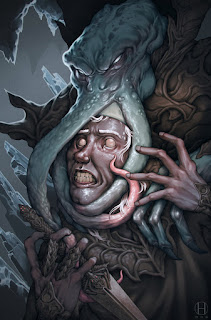
Mind Flayer (7) – aberration (arcana)
  • 1 Tattered Breastplate
  • 2d2 Mind Flayer Tentacles: Can be consumed as an action to grant Telepathy out to 120 feet for 1 hour.
  • 1 Mind Flayer Brain: Can be communicated telepathically if the brain is kept preserved in fluid. While preserved this way, the brain can use its Mind Blast ability. Can be carefully crafted (divination) by a spellcaster into a grotesque Helm of Telepathy.
  • 2 Mind Flayer Eyes: Can be used to cast Detect Thoughts, which destroys the eye. When cast this way, the spell does not require concentration but can only be used to detect the presence of thinking creatures as described in the spell, not to read their thoughts.
  • 1 Mind Flayer Heart: While holding the heart, it can be used to cast Plane Shift as a ritual. Only the creature holding the heart may shift. This consumes the heart. When the spell is cast, roll 1d20. On a 1, the bearer is sent to the intended destination, but also transported 1d10 years into the future.
  • 1 Hive Mind Colony Locator: A small trinket that magically points towards the Mind Flayer’s colony.
  • In Lair: 2d10 Thralls (various races) in the Mind Flayer’s command

Minotaur (3) – monstrosity (nature)
  • 1 Tattered Greataxe
  • 2 Minotaur Horns: No immediate use. Can be mastercrafted (alchemist’s supplies) into a Potion of Recall, which grants the drinker the ability to perfectly recall any path they have traveled for up to 8 hours. The drinker automatically succeeds on saving throws made to escape the Maze spell and similar areas.
  • 1 Minotaur Hide: Acts as a blanket. Can be crafted (leatherworker’s tools) into the equivalent of Scale mail.

Modrons

Note: A Modron’s body disintegrates upon death, destroying most of the loot it would have offered.

Monodrone (1/8) – construct (arcana)
  • 1 Tattered Weapon (50% Dagger, 50% Javelin)

Duodrone (1/4) – construct (arcana)
  • 1 Tattered Javelin

Tridrone (1/2) – construct (arcana)
  • 2 Tattered Javelin

Quadrone (1) – construct (arcana)
  • 1 Tattered Shortbow
  • 1 Cog of Primus: 100 can be mastercrafted (tinker’s tools) into a Monodrone

Pentadrone (2) – construct (arcana)
  • 10 Cogs of Primus: 100 can be mastercrafted (tinker’s tools) into a Monodrone
  • 1 Gyro of Primus: 1000 can be mastercrafted (tinker’s tools) into a Duodrone

Mummy (3) – undead (religion)
  • 1 Rotting Hand: Acts as an improvised weapon. A creature hit by the hand must succeed on a DC 12 Constitution saving throw or be cursed with mummy rot. The cursed target can’t regain hit points, and its hit point maximum decreases by 10 (3d6) for every 24 hours that elapse. If the curse reduces the target’s hit point maximum to 0, the target dies, and its body turns to dust. The curse lasts until removed by the Remove Curse spell or other magic. After 24 hours, if the Heart of the Mummy still exists, the Rotting Hand becomes a Crawling Claw whose attacks gain the properties of the Rotting Hand.
  • 1 Roll of Ceremonial Wrapping: Can be used as a substitute for the material components of a Create Undead spell. If used this way, the spell can create a mummy when cast as an 8th –level spell.
  • 1 Heart of the Mummy: Found if the mummy is defeated near its sarcophagus. Can be consumed, or used as the material component of a Legend Lore spell, to learn the details of the mummy’s life and compulsions. Can be mastercrafted (alchemist’s supplies) into a Potion of Necrotic Resistance.


https://artistjourney.wordpress.com/2014/01/16/l5r-art-noekam-the-mummy-lord/
Feel free to make your Mummy Lord look like Dwayne "The Rock" Johnson
Mummy Lord (15) – undead (religion)
  • 2 Rotting Lord Hands: Acts as an improvised weapon. A creature hit by the hand must succeed on a DC 16 Constitution saving throw or be cursed with mummy rot. The cursed target can’t regain hit points, and its hit point maximum decreases by 10 (3d6) for every 24 hours that elapse. If the curse reduces the target’s hit point maximum to 0, the target dies, and its body turns to dust. The curse lasts until removed by the Remove Curse spell or other magic. After 24 hours, if the Heart of the Mummy Lord still exists, the Rotting Hand becomes a Crawling Claw whose attacks gain the properties of the Rotting Hand.
  • 3 Rolls of Ceremonial Wrapping: Can be used as a substitute for the material components of a Create Undead spell. If used this way, the spell can create a mummy when cast as an 8th –level spell.
  • 1 Set of Ancient Regalia: Priceless to a historian interested in the mummy lord’s time period. Grants advantage on Charisma checks made to influence mummies and other creatures aware of the mummy lord’s status.
  • 1 Ancient Crown: Priceless to a historian interested in the mummy lord’s time period. Requires attunement. While attuned to the crown, a creature can use their action to channel the forces of the negative energy plane. Until the end of the creature’s next turn, any other creature within 60 feet, including those behind barriers and around corners, can’t regain hit points. Once this ability has been used, it cannot be used again until the next dawn.
  • 4 Vials of Mummy Lord Dust: Acts as Dust of Sneezing and Choking. Can be mastercrafted (conjuration) by a spellcaster into a totem that can be crushed to cast Dimension Door.
  • 2 Eyes of the Mummy Lord: Can be consumed to gain immunity to bludgeoning, slashing, and piercing damage from nonmagical weapons for 1 hour. During this time, the user is vulnerable to fire damage. Can be mastercrafted (alchemist’s supplies) into Mummy Lord Poison. A creature subjected to this poison must succeed on a DC 16 Constitution saving throw or be poisoned for 1 hour. The poisoned creature is paralyzed. The creature can repeat the saving throw at the end of each of its turns, ending the effect on itself on a success.
  • 1 Tongue of the Mummy Lord: Can be used to cast Contagion (+9 to hit, save DC 17), inflicting Slimy Doom. Once the disease has been inflicted upon a creature, the tongue shrivels and becomes useless.
  • 1 Vial of Sacred Mummy Oil: Can be used as a substitute for the material components of a Create Undead spell. If the spell is cast at 9th level on the same corpse for 60 continuous days, with the oil used as the material component of the spell on the final day, the corpse becomes a Mummy Lord. It retains its personality, goals, and memories from life, and is not bound to serve the spellcaster. It may, however, be convinced that the caster should be rewarded for their service and devotion.
  • 1 Heart of the Mummy Lord: This item is not found with the Mummy Lord unless the check made to loot the body was made in the Mummy Lord’s lair and was a 30 or higher. At the DM’s discretion, this loot may simply be a clue to the heart’s true location, not the heart itself. Can be used as the material component of a Legend Lore spell to learn the details of the mummy’s life and compulsions (this does not destroy the heart). If not destroyed, the Mummy Lord reforms in 24 hours. Any body parts of the Mummy Lord that have been looted crumble into dust, except the Rotting Lord Hands, which remain as Crawling Claws. The Mummy Lord grows new hands with its body.

Myconids

Myconid Sprout (0) – plant (nature)
  • Myconid Malt: No immediate use. Can be carefully crafted (brewer’s supplies) into a delicious beverage that causes the drinker to become intoxicated (as the poisoned condition) for 1d4 hours and grants telepathy out to 30 feet for this duration.

Spore Servant (-1 from creature) – plant (nature)
The creature loses any loot related to its weapons, and any loot that would confer a special sense or language associated with the creature

Myconid Adult (1/2) – plant (nature)
  • Myconid Malt: No immediate use. Can be carefully crafted (brewer’s supplies) into a delicious beverage that causes the drinker to become intoxicated (as the poisoned condition) for 1d4 hours and grants telepathy out to 30 feet for this duration.

Myconid Sovereign (2) – plant (nature)
  • Myconid Malt: No immediate use. Can be carefully crafted (brewer’s supplies) into a delicious beverage that causes the drinker to become intoxicated (as the poisoned condition) for 1d4 hours and grants telepathy out to 30 feet for this duration.
  • Sovereign Malt: No immediate use. Can be carefully crafted (brewer’s supplies) into a fantastically delicious beverage that causes the drinker to become intoxicated (as the poisoned condition) for 1d8 hours. At the end of this time, the drinker must make a DC 12 Constitution save or drop to 0 hit points, remaining stable but unconscious. If they do not receive magical healing within 24 hours, they die and rise as a spore servant.


Next week, we'll dig into one of the first (and gooiest) kind of monsters I ever used. Stay tuned!

http://paizo.com/products/btpy99tl?Cubie-the-Plush-Gelatinous-Cube
Who could be afraid of a face like that?

Thanks for reading!